

Demand Submission
Please leave us a message and we will contact you within 24 hours
APPLICATION
Our silicone products are used in all walks of life
APPLICATION
Our silicone products are used in all walks of life
Braided Silicone Hose for Oxygen Concentrators: Construction, Specification and Sourcing
2026-10-16 16:54:04
Click:
“
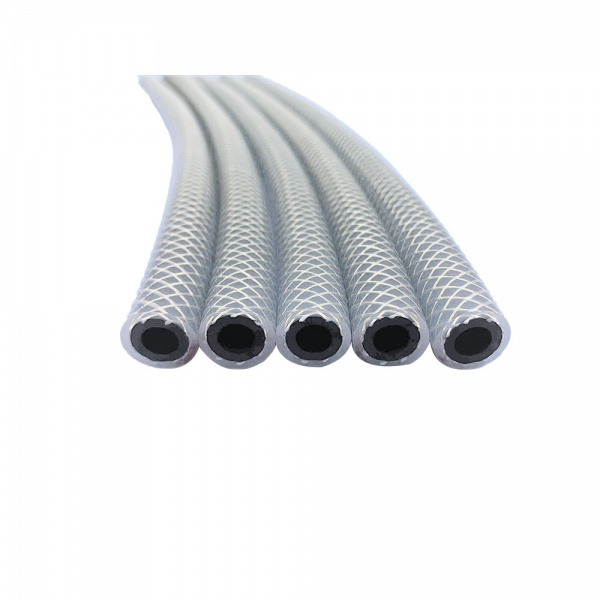
Braided silicone hose is used inside oxygen concentrators wherever tubing must carry pressure or withstand vacuum without collapsing or kinking. A polyester reinforcement layer is bonded between a platinum-cured silicone inner layer and a silicone outer jacket. Yutian Silicone manufactures it in eleven standard bore sizes from 3 mm to 31.75 mm, with cleanroom production and ISO 10993 reports available according to customer requirements.
”
Application Guide · Medical & Respiratory Equipment
Yutian Silicone has extruded silicone hose in Dongguan, China since 2012 and supplies medical braided silicone hose to respiratory equipment manufacturers as an OEM component. This page covers why reinforced tubing is used on oxygen concentrators, how the three-layer construction behaves on the pneumatic circuit, which specification inputs we need from you, and what documentation can be supplied with the part.
| Standard bore range3–31.75 mm | Continuous temp−40 to +200 °C | CuringPlatinum | Manufacturer since2012 |
Why reinforced tubing is used in an oxygen concentrator
A portable or stationary oxygen concentrator is not a simple air path. Air is compressed, pushed through a sieve bed, and then exhausted back out — so the same machine contains lines running above atmospheric pressure and lines running below it. That combination is what makes ordinary unreinforced silicone tubing the wrong choice in several positions:
- Vacuum collapse. An unreinforced silicone tube is soft. Under enough negative pressure it flattens, the bore closes, and flow stops. A braid layer prevents this.
- Kinking at tight bends. Concentrator chassis are compact and the tubing route is rarely straight. A plain tube kinks at a bend and silently restricts flow; a reinforced tube holds its bore open at a tighter radius.
- Pulsing and pressure cycling. Every start, stop and switchover of the pressure swing cycle flexes the line. Reinforcement limits wall movement and improves fatigue behaviour over the life of the unit.
- Wall thickness versus flexibility. Without reinforcement, the only way to resist pressure is to add wall thickness — which makes the hose stiff and hard to route. The braid carries the load instead, so the silicone can stay flexible.
There is a second reason specific to this application: the inner surface. Oxygen contacts the tube bore, so the material in contact with the gas is platinum-cured medical and food-grade silicone, and the braid is fully encapsulated between two silicone layers. The reinforcement never touches the gas path.
The three-layer construction, layer by layer
| Layer | Material | Function |
|---|---|---|
| Inner tube | Platinum-cured medical and food-grade silicone | Gas contact surface. Smooth bore, low extractables, cleanable. |
| Reinforcement | High-temperature polyester braid | Carries pressure load, resists vacuum collapse, prevents kinking. |
| Outer jacket | Silicone | Encapsulates the braid, protects against abrasion and handling. |
Because all three layers are silicone or encapsulated inside silicone, the finished hose stays transparent. That matters on a concentrator: an engineer or service technician can see the bore and check for contamination or condensate without cutting the line open.
Documented performance for the standard construction: hardness 70 Shore A inner / 60 Shore A outer · density 1.2 ± 0.1 g/cm³ · tensile strength ≥ 8.6 MPa · tear strength ≥ 32 kN/m · elongation at break ≥ 360 % · continuous service temperature −40 to +200 °C (−40 to 392 °F) · suitable for full vacuum · packaging 1–15 m per bag · ROHS, FDA, LFGB and NSF compliance. Not for human implant.
Where the braided tube sits on the pneumatic circuit
Oxygen concentrators differ in architecture, but the tubing routes below are where reinforced hose is normally specified. Use this as a checklist against your own bill of materials — the tube positions are described generically because every platform lays them out differently:
- Compressor discharge line — the highest continuous pressure in the machine, and the first place a plain tube will fail or balloon.
- Lines into and out of the sieve beds — these see the full pressure/vacuum swing of the PSA cycle, so the tube wall is flexing constantly.
- Vacuum and exhaust lines — negative pressure, where collapse is the failure mode rather than burst.
- Internal routing through a tight chassis — any run with a bend radius tighter than a plain silicone tube will tolerate.
- Connection from the outlet port to the delivery line — the patient-adjacent path, where the cleanable silicone bore is the reason for the material choice.
- Condensate and drain lines — including peristaltic pump duty, where the tube is squeezed thousands of times and fatigue life decides service intervals.
Standard and custom constructions: what is shared and what differs
We build three reinforcement options, and all three are available for oxygen concentrator tubing:
| Construction | Reinforcement layer | Status |
|---|---|---|
| Polyester braid | High-temperature polyester yarn, braided | Standard |
| Mesh braid | Polyester mesh fabric as the reinforcement layer | Custom option |
| Steel wire braid | Stainless steel wire reinforcement | Custom option |
Two points that matter when you are comparing quotes, because suppliers handle them differently:
The published specification is shared across all three constructions. The bore range, wall options, hardness, tensile and tear data and the temperature range above apply to the product family as a whole — the reinforcement layer changes how the hose performs under pressure, not the material data. We do not publish a separate parameter set for mesh and steel wire, and you should be cautious of any supplier who does so without reference to your specific line.
Mesh and steel wire are custom builds. They exist for applications with higher pressure requirements than a standard textile braid is intended to carry. They are evaluated and quoted per project, against your working pressure, peak pressure, vacuum level, temperature and bend radius — so the right time to raise them is at the specification stage, not after sampling.
Specification inputs we need to quote oxygen concentrator tubing
If you have a drawing, send it. If you do not, these are the answers that let us propose a tube — you do not need all of them to start a conversation:
| Input | What to tell us |
|---|---|
| Bore and wall | ID and OD, or ID and wall thickness, with the tolerance you can accept |
| Pressure duty | Working pressure and peak pressure, stated separately from any burst figure |
| Vacuum duty | Whether the line goes negative, and how far — this is the input most often left off an RFQ |
| Temperature | Continuous and peak, and whether it is the gas or the surrounding air that is warm |
| Media | Oxygen, humidified oxygen, ambient air, or condensate from the sieve cycle |
| Bend radius in the machine | The radius the tube must survive in the chassis, not on a bench |
| Cycling behaviour | Static route, pressure cycling, or peristaltic pump duty |
| Ends and connections | Plain cut ends, or an assembly. We manufacture the silicone tube; fittings, clamps and other non-silicone components can be integrated through our partner network as a complete assembly. They are not made in our factory. |
| Compliance and cleanliness | Which documents your regulatory file requires — see the section below |
| Length, quantity, packaging | Cut length per piece, annual or per-order volume, and how the parts must be bagged and labelled |
| Colour and marking | Transparent as standard; any identification marking your build requires |
Cleanroom production and documentation
Not every concentrator project needs the same paperwork. What we can supply is set out below, and the deciding factor is your own regulatory pathway — the device belongs to you, and its classification, testing and submission are yours to define. Our part of the job is to make the tubing and the documents that support your file.
| Item | Status |
|---|---|
| Class 100,000 cleanroom production | Can be provided according to customer requirements |
| ISO 10993 biocompatibility test reports | Three reports: cytotoxicity, skin sensitization, skin irritation. Can be provided according to customer requirements. |
| ISO 13485 | Can be provided according to customer requirements |
| FDA, LFGB, NSF, ROHS | Held at company level |
| Material and dimensional data | Published specification, above; part-specific data on request |
Two clarifications worth stating plainly. ISO 10993 is a standard with many parts; what we hold is three biological evaluation reports — cytotoxicity, skin sensitization and skin irritation. And while this hose is built from medical-grade materials in a medical-grade process, it is a component, not an implantable device: it is not intended for human implant.
Tell us at the specification stage which documents your file needs. Adding them is a matter of scheduling the order correctly — discovering the requirement after sampling costs a cycle.
Sampling and lead times
| Stage | Lead time |
|---|---|
| In-stock samples | Ship in 3 days |
| Standard parts | Typically 5–7 days |
| Custom and project-specific parts | 10–20 working days, depending on specification and quantity |
Manufacturing is carried out in a 6,800 m² facility in Dongguan with 14 extrusion lines, 4 calendering lines and 7 compression moulding lines, and capacity up to 8,000,000 meters per month. Our production team is over 90 people, supported by more than 50 in management, engineering and sales.
Common specification mistakes on concentrator tubing
- Leaving vacuum off the RFQ. The most frequent omission, and the one that produces a tube that collapses in the field.
- Specifying a thicker wall to solve a pressure problem. It stiffens the hose and makes routing worse; reinforcement is the correct lever.
- Comparing a burst figure against a working requirement. Burst is the failure threshold, not a design rating.
- Ignoring the bend radius inside the chassis. A tube that kinks in the machine has failed, whatever the datasheet says.
- Choosing an unreinforced tube to save cost on a vacuum line. The saving is real until the first field complaint.
- Raising documentation requirements after sampling. Cleanroom runs, ISO 10993 reports and ISO 13485 documentation are best planned into the order from the start.
Frequently asked questions
Can braided silicone hose be used in an oxygen concentrator?
Yes. Reinforced silicone tubing is well suited to the pressure and vacuum sections of a concentrator because the braid stops the tube collapsing under vacuum and kinking at tight bends, while the platinum-cured silicone bore keeps the gas path in medical and food-grade material.
Is it suitable for oxygen service?
The inner layer that contacts the gas is platinum-cured medical and food-grade silicone, and the braid is fully encapsulated so it never touches the gas path. You should confirm compatibility against your own oxygen-service and cleaning requirements — the final specification decision, and the device submission, rest with you.
What temperature range does the hose handle?
−40 to +200 °C (−40 to 392 °F) continuous for the standard construction. If your unit runs hotter anywhere on the circuit, say so at the specification stage.
Which sizes do you hold?
Eleven standard models with bores from 3 mm to 31.75 mm in the reinforced range, with wall thicknesses from 2.5 mm upward. Other bore and wall combinations are possible as custom items.
Do you offer mesh and steel wire braided versions for higher pressures?
Yes, both are available as custom options for higher pressure requirements. They are made to order and quoted per project, so send your working and peak pressure, vacuum level and temperature and we will recommend the construction.
Do the three constructions have different specifications?
The published material and dimensional data apply to the product family. The reinforcement layer changes how the hose performs under pressure and vacuum rather than the silicone data itself. Mesh and steel wire are engineered to your duty, so they are quoted per project instead of from a fixed table.
Is the hose produced in a cleanroom?
We operate a Class 100,000 cleanroom, and cleanroom production can be provided according to customer requirements. If your project needs it, tell us at the specification stage so it is scheduled into the order.
What biocompatibility documentation can you provide?
ISO 10993 biocompatibility test reports covering cytotoxicity, skin sensitization and skin irritation can be provided according to customer requirements, along with ISO 13485 documentation. FDA, LFGB, NSF and ROHS compliance is held at company level.
Can you supply the tube with fittings attached?
We manufacture the silicone tube. Fittings, clamps and other non-silicone components can be integrated through our partner network and supplied as an assembly; they are not manufactured in our factory.
Can I get samples before committing to a production order?
Yes. In-stock samples ship in 3 days. Standard parts are typically 5–7 days, and custom parts 10–20 working days depending on specification and quantity.
Can this tube be used for implantation?
No. It is manufactured from medical-grade materials and can be produced in a cleanroom, but it is a component for equipment and is not intended for human implant.
Do you also supply braided hose for other medical and appliance applications?
Yes. The same reinforced construction is used across medical, food and beverage, laboratory and appliance equipment. The oxygen concentrator is one application of a standard product family.
Related reading
- Braided vs reinforced vs steel wire silicone hose — which reinforcement to choose, and the published specification for the standard braid.
- How OEM medical silicone hose projects work — the sourcing process from specification inputs to lead time.
- Polyester braided silicone hose — the standard construction in detail.
Next step
Send us the bore and wall, working and peak pressure, vacuum level, temperature, media, the bend radius the tube must survive inside the chassis, your documentation requirements and the quantity. If you have a drawing, that is faster — if you do not, the answers above are enough to start. We will come back with the construction we recommend for each position, the tube specification, and the applicable lead time.
Sourcing tubing for an oxygen concentrator project?
Send your tube drawing or working conditions and we will recommend the construction and confirm lead time in one reply.
DongGuan Yutian Silicone Rubber Technology Co., Ltd — silicone extrusion manufacturer since 2012. 6,800 m² facility · 14 extrusion lines · 4 calendering lines · 7 compression moulding lines · Class 100,000 cleanroom · monthly capacity up to 8,000,000 meters. Room 801, Building 10, No. 2 Tutang Industrial 2nd Heng Road, Changping Town, Dongguan, Guangdong, China.
Author:
Dongguan Yutian Silicone Rubber Technology Co., Lt
0
Products Recommended






INQUIRY


Add Successfully
Braided Silicone Hose for Oxygen Concentrators: Construction, Specification and Sourcing
Author:Dongguan Yutian Silicone Rubber Technology Co., Lt
Application Guide · Medical & Respiratory Equipment
Yutian Silicone has extruded silicone hose in Dongguan, China since 2012 and supplies medical braided silicone hose to respiratory equipment manufacturers as an OEM component. This page covers why reinforced tubing is used on oxygen concentrators, how the three-layer construction behaves on the pneumatic circuit, which specification inputs we need from you, and what documentation can be supplied with the part.
| Standard bore range3–31.75 mm | Continuous temp−40 to +200 °C | CuringPlatinum | Manufacturer since2012 |
Why reinforced tubing is used in an oxygen concentrator
A portable or stationary oxygen concentrator is not a simple air path. Air is compressed, pushed through a sieve bed, and then exhausted back out — so the same machine contains lines running above atmospheric pressure and lines running below it. That combination is what makes ordinary unreinforced silicone tubing the wrong choice in several positions:
- Vacuum collapse. An unreinforced silicone tube is soft. Under enough negative pressure it flattens, the bore closes, and flow stops. A braid layer prevents this.
- Kinking at tight bends. Concentrator chassis are compact and the tubing route is rarely straight. A plain tube kinks at a bend and silently restricts flow; a reinforced tube holds its bore open at a tighter radius.
- Pulsing and pressure cycling. Every start, stop and switchover of the pressure swing cycle flexes the line. Reinforcement limits wall movement and improves fatigue behaviour over the life of the unit.
- Wall thickness versus flexibility. Without reinforcement, the only way to resist pressure is to add wall thickness — which makes the hose stiff and hard to route. The braid carries the load instead, so the silicone can stay flexible.
There is a second reason specific to this application: the inner surface. Oxygen contacts the tube bore, so the material in contact with the gas is platinum-cured medical and food-grade silicone, and the braid is fully encapsulated between two silicone layers. The reinforcement never touches the gas path.
The three-layer construction, layer by layer
| Layer | Material | Function |
|---|---|---|
| Inner tube | Platinum-cured medical and food-grade silicone | Gas contact surface. Smooth bore, low extractables, cleanable. |
| Reinforcement | High-temperature polyester braid | Carries pressure load, resists vacuum collapse, prevents kinking. |
| Outer jacket | Silicone | Encapsulates the braid, protects against abrasion and handling. |
Because all three layers are silicone or encapsulated inside silicone, the finished hose stays transparent. That matters on a concentrator: an engineer or service technician can see the bore and check for contamination or condensate without cutting the line open.
Documented performance for the standard construction: hardness 70 Shore A inner / 60 Shore A outer · density 1.2 ± 0.1 g/cm³ · tensile strength ≥ 8.6 MPa · tear strength ≥ 32 kN/m · elongation at break ≥ 360 % · continuous service temperature −40 to +200 °C (−40 to 392 °F) · suitable for full vacuum · packaging 1–15 m per bag · ROHS, FDA, LFGB and NSF compliance. Not for human implant.
Where the braided tube sits on the pneumatic circuit
Oxygen concentrators differ in architecture, but the tubing routes below are where reinforced hose is normally specified. Use this as a checklist against your own bill of materials — the tube positions are described generically because every platform lays them out differently:
- Compressor discharge line — the highest continuous pressure in the machine, and the first place a plain tube will fail or balloon.
- Lines into and out of the sieve beds — these see the full pressure/vacuum swing of the PSA cycle, so the tube wall is flexing constantly.
- Vacuum and exhaust lines — negative pressure, where collapse is the failure mode rather than burst.
- Internal routing through a tight chassis — any run with a bend radius tighter than a plain silicone tube will tolerate.
- Connection from the outlet port to the delivery line — the patient-adjacent path, where the cleanable silicone bore is the reason for the material choice.
- Condensate and drain lines — including peristaltic pump duty, where the tube is squeezed thousands of times and fatigue life decides service intervals.
Standard and custom constructions: what is shared and what differs
We build three reinforcement options, and all three are available for oxygen concentrator tubing:
| Construction | Reinforcement layer | Status |
|---|---|---|
| Polyester braid | High-temperature polyester yarn, braided | Standard |
| Mesh braid | Polyester mesh fabric as the reinforcement layer | Custom option |
| Steel wire braid | Stainless steel wire reinforcement | Custom option |
Two points that matter when you are comparing quotes, because suppliers handle them differently:
The published specification is shared across all three constructions. The bore range, wall options, hardness, tensile and tear data and the temperature range above apply to the product family as a whole — the reinforcement layer changes how the hose performs under pressure, not the material data. We do not publish a separate parameter set for mesh and steel wire, and you should be cautious of any supplier who does so without reference to your specific line.
Mesh and steel wire are custom builds. They exist for applications with higher pressure requirements than a standard textile braid is intended to carry. They are evaluated and quoted per project, against your working pressure, peak pressure, vacuum level, temperature and bend radius — so the right time to raise them is at the specification stage, not after sampling.
Specification inputs we need to quote oxygen concentrator tubing
If you have a drawing, send it. If you do not, these are the answers that let us propose a tube — you do not need all of them to start a conversation:
| Input | What to tell us |
|---|---|
| Bore and wall | ID and OD, or ID and wall thickness, with the tolerance you can accept |
| Pressure duty | Working pressure and peak pressure, stated separately from any burst figure |
| Vacuum duty | Whether the line goes negative, and how far — this is the input most often left off an RFQ |
| Temperature | Continuous and peak, and whether it is the gas or the surrounding air that is warm |
| Media | Oxygen, humidified oxygen, ambient air, or condensate from the sieve cycle |
| Bend radius in the machine | The radius the tube must survive in the chassis, not on a bench |
| Cycling behaviour | Static route, pressure cycling, or peristaltic pump duty |
| Ends and connections | Plain cut ends, or an assembly. We manufacture the silicone tube; fittings, clamps and other non-silicone components can be integrated through our partner network as a complete assembly. They are not made in our factory. |
| Compliance and cleanliness | Which documents your regulatory file requires — see the section below |
| Length, quantity, packaging | Cut length per piece, annual or per-order volume, and how the parts must be bagged and labelled |
| Colour and marking | Transparent as standard; any identification marking your build requires |
Cleanroom production and documentation
Not every concentrator project needs the same paperwork. What we can supply is set out below, and the deciding factor is your own regulatory pathway — the device belongs to you, and its classification, testing and submission are yours to define. Our part of the job is to make the tubing and the documents that support your file.
| Item | Status |
|---|---|
| Class 100,000 cleanroom production | Can be provided according to customer requirements |
| ISO 10993 biocompatibility test reports | Three reports: cytotoxicity, skin sensitization, skin irritation. Can be provided according to customer requirements. |
| ISO 13485 | Can be provided according to customer requirements |
| FDA, LFGB, NSF, ROHS | Held at company level |
| Material and dimensional data | Published specification, above; part-specific data on request |
Two clarifications worth stating plainly. ISO 10993 is a standard with many parts; what we hold is three biological evaluation reports — cytotoxicity, skin sensitization and skin irritation. And while this hose is built from medical-grade materials in a medical-grade process, it is a component, not an implantable device: it is not intended for human implant.
Tell us at the specification stage which documents your file needs. Adding them is a matter of scheduling the order correctly — discovering the requirement after sampling costs a cycle.
Sampling and lead times
| Stage | Lead time |
|---|---|
| In-stock samples | Ship in 3 days |
| Standard parts | Typically 5–7 days |
| Custom and project-specific parts | 10–20 working days, depending on specification and quantity |
Manufacturing is carried out in a 6,800 m² facility in Dongguan with 14 extrusion lines, 4 calendering lines and 7 compression moulding lines, and capacity up to 8,000,000 meters per month. Our production team is over 90 people, supported by more than 50 in management, engineering and sales.
Common specification mistakes on concentrator tubing
- Leaving vacuum off the RFQ. The most frequent omission, and the one that produces a tube that collapses in the field.
- Specifying a thicker wall to solve a pressure problem. It stiffens the hose and makes routing worse; reinforcement is the correct lever.
- Comparing a burst figure against a working requirement. Burst is the failure threshold, not a design rating.
- Ignoring the bend radius inside the chassis. A tube that kinks in the machine has failed, whatever the datasheet says.
- Choosing an unreinforced tube to save cost on a vacuum line. The saving is real until the first field complaint.
- Raising documentation requirements after sampling. Cleanroom runs, ISO 10993 reports and ISO 13485 documentation are best planned into the order from the start.
Frequently asked questions
Can braided silicone hose be used in an oxygen concentrator?
Yes. Reinforced silicone tubing is well suited to the pressure and vacuum sections of a concentrator because the braid stops the tube collapsing under vacuum and kinking at tight bends, while the platinum-cured silicone bore keeps the gas path in medical and food-grade material.
Is it suitable for oxygen service?
The inner layer that contacts the gas is platinum-cured medical and food-grade silicone, and the braid is fully encapsulated so it never touches the gas path. You should confirm compatibility against your own oxygen-service and cleaning requirements — the final specification decision, and the device submission, rest with you.
What temperature range does the hose handle?
−40 to +200 °C (−40 to 392 °F) continuous for the standard construction. If your unit runs hotter anywhere on the circuit, say so at the specification stage.
Which sizes do you hold?
Eleven standard models with bores from 3 mm to 31.75 mm in the reinforced range, with wall thicknesses from 2.5 mm upward. Other bore and wall combinations are possible as custom items.
Do you offer mesh and steel wire braided versions for higher pressures?
Yes, both are available as custom options for higher pressure requirements. They are made to order and quoted per project, so send your working and peak pressure, vacuum level and temperature and we will recommend the construction.
Do the three constructions have different specifications?
The published material and dimensional data apply to the product family. The reinforcement layer changes how the hose performs under pressure and vacuum rather than the silicone data itself. Mesh and steel wire are engineered to your duty, so they are quoted per project instead of from a fixed table.
Is the hose produced in a cleanroom?
We operate a Class 100,000 cleanroom, and cleanroom production can be provided according to customer requirements. If your project needs it, tell us at the specification stage so it is scheduled into the order.
What biocompatibility documentation can you provide?
ISO 10993 biocompatibility test reports covering cytotoxicity, skin sensitization and skin irritation can be provided according to customer requirements, along with ISO 13485 documentation. FDA, LFGB, NSF and ROHS compliance is held at company level.
Can you supply the tube with fittings attached?
We manufacture the silicone tube. Fittings, clamps and other non-silicone components can be integrated through our partner network and supplied as an assembly; they are not manufactured in our factory.
Can I get samples before committing to a production order?
Yes. In-stock samples ship in 3 days. Standard parts are typically 5–7 days, and custom parts 10–20 working days depending on specification and quantity.
Can this tube be used for implantation?
No. It is manufactured from medical-grade materials and can be produced in a cleanroom, but it is a component for equipment and is not intended for human implant.
Do you also supply braided hose for other medical and appliance applications?
Yes. The same reinforced construction is used across medical, food and beverage, laboratory and appliance equipment. The oxygen concentrator is one application of a standard product family.
Related reading
- Braided vs reinforced vs steel wire silicone hose — which reinforcement to choose, and the published specification for the standard braid.
- How OEM medical silicone hose projects work — the sourcing process from specification inputs to lead time.
- Polyester braided silicone hose — the standard construction in detail.
Next step
Send us the bore and wall, working and peak pressure, vacuum level, temperature, media, the bend radius the tube must survive inside the chassis, your documentation requirements and the quantity. If you have a drawing, that is faster — if you do not, the answers above are enough to start. We will come back with the construction we recommend for each position, the tube specification, and the applicable lead time.
Sourcing tubing for an oxygen concentrator project?
Send your tube drawing or working conditions and we will recommend the construction and confirm lead time in one reply.
DongGuan Yutian Silicone Rubber Technology Co., Ltd — silicone extrusion manufacturer since 2012. 6,800 m² facility · 14 extrusion lines · 4 calendering lines · 7 compression moulding lines · Class 100,000 cleanroom · monthly capacity up to 8,000,000 meters. Room 801, Building 10, No. 2 Tutang Industrial 2nd Heng Road, Changping Town, Dongguan, Guangdong, China.









Products Recommended
INQUIRY
Add Successfully
Products Recommended
Products Recommended
INQUIRY
Add Successfully
 Brown Di
 Brown Di