

Demand Submission
Please leave us a message and we will contact you within 24 hours
NEWS CENTER
A variety of production processes, research and development, production, sales integration
NEWS CENTER
A variety of production processes, research and development, production, sales integration
Silicone Sealing Strip for Kitchen Cabinets and Wardrobes
Time: 2026-11-26 14:39:36
Author: DongGuan Yutian Silicone Rubber Technology Co.,Ltd
Click:
Kitchen and wardrobe seals fail when foam tape flattens and PVC hardens. This guide covers dust, moisture, soft close, profile choice and what to specify for furniture.
Direct answer: A kitchen cabinet or wardrobe seal does three jobs: it keeps dust off the contents, it keeps moisture away from the board edge, and it stops a door from closing with a hard knock. A soft silicone strip does all three without the compression set that flattens foam tape and PVC strip within a season, which is why cabinet makers who have tried it tend to keep it in the standard bill of materials.
Cabinet sealing is a small part of the cost of a kitchen or a wardrobe and a large part of how the finished job feels. A door that closes with a soft thud and opens without a rattle reads as quality; the same door with a perished foam strip reads as cheap after a year. This article covers what the strip is doing, why the usual foam and PVC options fail indoors, and how to specify a silicone strip that survives the life of the cabinet.
What the strip is actually doing
- Dust: a continuous soft seal at the door edge stops dust tracking along the gap, which matters most for wardrobe doors and open-shelf pantry units.
- Moisture: under-sink and sink-adjacent cabinets see splashes and humidity. A closed silicone edge keeps water off the board edge, where swelling starts.
- Sound and feel: a compressible strip takes the knock out of a closing door and stops the door rattling against the frame.
- Gap tolerance: a soft profile absorbs small variations in door alignment and panel thickness better than a rigid trim.
Why foam tape and PVC strip fail indoors
Polyurethane and EVA foam tapes are cheap, easy to apply and work well for the first months. Then the foam takes a permanent set: it compresses to a thin film and stops springing back, so the door no longer seals and the gap reappears. PVC strip behaves differently but ends in the same place, because plasticiser migrates out and the strip hardens and yellows, especially where sunlight reaches it.
Adhesive is the other failure. Most foam tapes are supplied with a pressure-sensitive adhesive that creeps in warm kitchens, lifts at the ends and lets dust and moisture behind the strip. That is why a mechanically retained silicone profile, or a silicone strip with a proper backing, outlasts a taped foam strip even at a higher unit cost.
Where silicone earns its price — and where it does not
| Application | Typical seal today | Where silicone helps |
|---|---|---|
| Kitchen cabinet doors | Foam or PVC tape | Long life, no compression set, cleanable surface |
| Under-sink cabinet | Foam tape | Water and cleaning chemicals at the board edge |
| Wardrobe doors | Foam tape or brush strip | Dust seal plus soft close without rattle |
| Sliding wardrobe doors | Brush or felt | Felt compacts; a silicone profile keeps its shape |
| Pantry and larder | Foam tape | Continuous seal and food-safe material |
| Decorative trim | PVC extrusion | Silicone is usually overkill unless heat or cleaning is involved |
Indicative comparison for furniture applications; the right choice depends on the door gap, the finish and the volume.
The honest answer is that silicone is not the cheapest option per metre, so it makes sense where the seal is expected to last as long as the cabinet, where water or cleaning chemicals reach it, or where the door is used heavily. For a decorative trim on a low-cost unit, PVC remains a rational choice.
Profile and mounting options
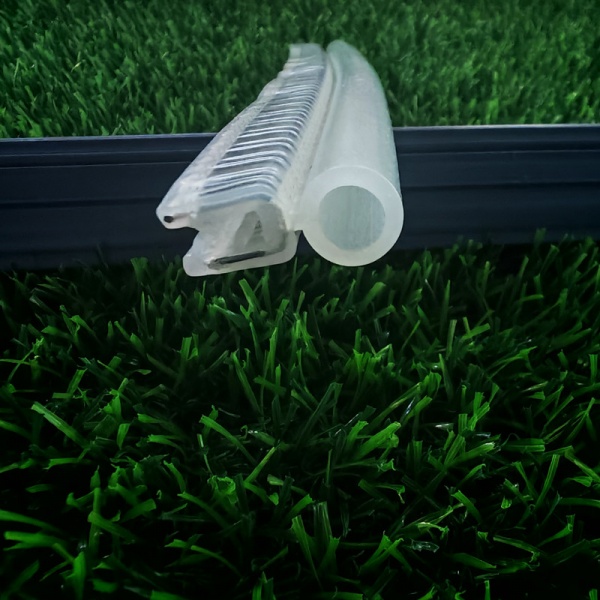
Furniture seals are usually one of four constructions: a flat strip with adhesive backing, a push-on profile that grips the panel edge, a U-shaped channel that fits over the board, or a hollow or double-cavity profile that compresses like a cushion. The double-cavity type is useful on cabinet doors because two cavities give a soft close over a wider gap range than a single hollow section. Our double-cavity silicone sealing strip is built for that duty, and the door and window sealing strip covers the narrower frame gaps.
Wet areas: under-sink, sink-adjacent and utility cabinets
The under-sink cabinet is the harshest indoor environment in a kitchen: splashes, occasional leaks, cleaning sprays and warm humid air. Foam there is a sponge, and a sponge against a chipboard edge is how a cabinet floor swells. A silicone strip does not absorb water, can be wiped down, and keeps the water at the face rather than in the board. If the cabinet also houses a dishwasher or a boiler, the temperature swings make silicone the more stable choice.
Wardrobes and sliding doors
On hinged wardrobe doors the goal is dust and soft close; on sliding doors it is dust plus reducing rattle as the panel moves. Felt and brush seals are common because they are cheap and thin, but felt compacts and brushes flatten, and both leave a gap at the corners. A silicone profile with a hollow section keeps pressure on the panel across the whole run and does not shed fibres onto clothes, which matters for retail and hotel fit-outs.
Colour, finish and the visible edge
On a visible door edge the strip becomes part of the design, so colour matching matters as much as performance. Silicone can be pigmented to a supplied sample, and it holds colour better than PVC under UV, which is why light-coloured strips on a sunny facade or a glazed wardrobe do not turn yellow. Send a physical colour reference rather than a screen colour; pigment matching is done against a sample, not against a hex code.
What to specify
- Door type, gap range and how the strip is retained — adhesive, groove or push-on.
- Environment: dry interior, under-sink humidity, or a glazed facade with sunlight.
- Cleaning chemicals the strip will see.
- Colour reference and whether the edge is visible.
- Door weight and how often it is opened, which sets the hardness and profile choice.
- Lengths and annual volume, and whether the first order is a trial batch.
Why the first order should be a sample run
A cabinet seal is judged by how it feels on a door that is already fitted, so the sensible first order is a sample length fitted to one door, closed a few hundred times, and checked for set marks, adhesion and colour. Tooling for a custom profile is a one-off die cost, samples run one to three rounds, and production is typically 10 to 20 working days after the drawing is agreed. The minimum order value is USD 500 per order, which suits a trial batch for a workshop or a first production run for a manufacturer.
Frequently asked questions
Is a silicone strip worth it on kitchen cabinets?
Where the cabinet is expected to last and the seal is under a door that is used daily, yes: it does not flatten like foam or harden like PVC, and it can be wiped clean. On decorative trim for a low-cost unit, PVC is usually the rational choice.
Can it be glued on instead of fitted in a groove?
Yes, with a suitable backing, but adhesive is the usual failure point in warm kitchens. Mechanical retention in a groove or a push-on profile avoids that failure entirely and is worth designing in if the cabinet is a repeat product.
Will it stop dust in a wardrobe?
A continuous soft seal at the door edge reduces dust tracking substantially, provided the corners are sealed too. Felt and brush strips leave corner gaps that a moulded or bonded silicone frame does not.
Does silicone yellow in sunlight?
It holds colour better than PVC, which is why light-coloured silicone strips stay stable on glazed wardrobes and sunny facades. Colour matching is done against a physical sample.
What is the minimum order?
The minimum order value is USD 500 per order. For a custom profile, a die is charged once per product, and samples are produced before the production run.
Send the door type, the gap and a colour reference, and we will propose a profile and send a sample length for a fitted trial. The full range is on our silicone sealing strip and gasket page.
Send your drawingWhatsApp +86 180 2892 1514 · salesmanager@yutiansilicone.com

点击右上角
分享给朋友吧







 Long by picture save/share
0
Popular
-
top Colored Silicone Tube: Production Process and How to Choose
-
top Enhancing the Lifespan of High-Temperature Silicone Tubes in...
-
top Introducing the Innovative Foam Silicone Tube: A High-Perfor...
-
The evolution and future of silicone material: a panoramic a...
-
Dongguan Yutian Silicone Rubber Technology Co., Ltd. Unveils...
-
Understanding the Causes of Bending and Clogging in Food-Gra...
-
Explore Cutting-Edge Silicone Solutions with Dongguan Yutian...
-
Dongguan Yutian Successfully Showcases Innovative Medical Si...
Latest Products






Message
Hi!If you are looking for custom-made silicone rubber products, feel free to ask me any questions.
Silicone Sealing Strip for Kitchen Cabinets and Wardrobes
Author:DongGuan Yutian Silicone Rubber Technology Co.,Ltd
Click:
Time:2026-11-26 14:39:36
Direct answer: A kitchen cabinet or wardrobe seal does three jobs: it keeps dust off the contents, it keeps moisture away from the board edge, and it stops a door from closing with a hard knock. A soft silicone strip does all three without the compression set that flattens foam tape and PVC strip within a season, which is why cabinet makers who have tried it tend to keep it in the standard bill of materials.
Cabinet sealing is a small part of the cost of a kitchen or a wardrobe and a large part of how the finished job feels. A door that closes with a soft thud and opens without a rattle reads as quality; the same door with a perished foam strip reads as cheap after a year. This article covers what the strip is doing, why the usual foam and PVC options fail indoors, and how to specify a silicone strip that survives the life of the cabinet.
What the strip is actually doing
- Dust: a continuous soft seal at the door edge stops dust tracking along the gap, which matters most for wardrobe doors and open-shelf pantry units.
- Moisture: under-sink and sink-adjacent cabinets see splashes and humidity. A closed silicone edge keeps water off the board edge, where swelling starts.
- Sound and feel: a compressible strip takes the knock out of a closing door and stops the door rattling against the frame.
- Gap tolerance: a soft profile absorbs small variations in door alignment and panel thickness better than a rigid trim.
Why foam tape and PVC strip fail indoors
Polyurethane and EVA foam tapes are cheap, easy to apply and work well for the first months. Then the foam takes a permanent set: it compresses to a thin film and stops springing back, so the door no longer seals and the gap reappears. PVC strip behaves differently but ends in the same place, because plasticiser migrates out and the strip hardens and yellows, especially where sunlight reaches it.
Adhesive is the other failure. Most foam tapes are supplied with a pressure-sensitive adhesive that creeps in warm kitchens, lifts at the ends and lets dust and moisture behind the strip. That is why a mechanically retained silicone profile, or a silicone strip with a proper backing, outlasts a taped foam strip even at a higher unit cost.
Where silicone earns its price — and where it does not
| Application | Typical seal today | Where silicone helps |
|---|---|---|
| Kitchen cabinet doors | Foam or PVC tape | Long life, no compression set, cleanable surface |
| Under-sink cabinet | Foam tape | Water and cleaning chemicals at the board edge |
| Wardrobe doors | Foam tape or brush strip | Dust seal plus soft close without rattle |
| Sliding wardrobe doors | Brush or felt | Felt compacts; a silicone profile keeps its shape |
| Pantry and larder | Foam tape | Continuous seal and food-safe material |
| Decorative trim | PVC extrusion | Silicone is usually overkill unless heat or cleaning is involved |
Indicative comparison for furniture applications; the right choice depends on the door gap, the finish and the volume.
The honest answer is that silicone is not the cheapest option per metre, so it makes sense where the seal is expected to last as long as the cabinet, where water or cleaning chemicals reach it, or where the door is used heavily. For a decorative trim on a low-cost unit, PVC remains a rational choice.
Profile and mounting options
Furniture seals are usually one of four constructions: a flat strip with adhesive backing, a push-on profile that grips the panel edge, a U-shaped channel that fits over the board, or a hollow or double-cavity profile that compresses like a cushion. The double-cavity type is useful on cabinet doors because two cavities give a soft close over a wider gap range than a single hollow section. Our double-cavity silicone sealing strip is built for that duty, and the door and window sealing strip covers the narrower frame gaps.
Wet areas: under-sink, sink-adjacent and utility cabinets
The under-sink cabinet is the harshest indoor environment in a kitchen: splashes, occasional leaks, cleaning sprays and warm humid air. Foam there is a sponge, and a sponge against a chipboard edge is how a cabinet floor swells. A silicone strip does not absorb water, can be wiped down, and keeps the water at the face rather than in the board. If the cabinet also houses a dishwasher or a boiler, the temperature swings make silicone the more stable choice.
Wardrobes and sliding doors
On hinged wardrobe doors the goal is dust and soft close; on sliding doors it is dust plus reducing rattle as the panel moves. Felt and brush seals are common because they are cheap and thin, but felt compacts and brushes flatten, and both leave a gap at the corners. A silicone profile with a hollow section keeps pressure on the panel across the whole run and does not shed fibres onto clothes, which matters for retail and hotel fit-outs.
Colour, finish and the visible edge
On a visible door edge the strip becomes part of the design, so colour matching matters as much as performance. Silicone can be pigmented to a supplied sample, and it holds colour better than PVC under UV, which is why light-coloured strips on a sunny facade or a glazed wardrobe do not turn yellow. Send a physical colour reference rather than a screen colour; pigment matching is done against a sample, not against a hex code.
What to specify
- Door type, gap range and how the strip is retained — adhesive, groove or push-on.
- Environment: dry interior, under-sink humidity, or a glazed facade with sunlight.
- Cleaning chemicals the strip will see.
- Colour reference and whether the edge is visible.
- Door weight and how often it is opened, which sets the hardness and profile choice.
- Lengths and annual volume, and whether the first order is a trial batch.
Why the first order should be a sample run
A cabinet seal is judged by how it feels on a door that is already fitted, so the sensible first order is a sample length fitted to one door, closed a few hundred times, and checked for set marks, adhesion and colour. Tooling for a custom profile is a one-off die cost, samples run one to three rounds, and production is typically 10 to 20 working days after the drawing is agreed. The minimum order value is USD 500 per order, which suits a trial batch for a workshop or a first production run for a manufacturer.
Frequently asked questions
Is a silicone strip worth it on kitchen cabinets?
Where the cabinet is expected to last and the seal is under a door that is used daily, yes: it does not flatten like foam or harden like PVC, and it can be wiped clean. On decorative trim for a low-cost unit, PVC is usually the rational choice.
Can it be glued on instead of fitted in a groove?
Yes, with a suitable backing, but adhesive is the usual failure point in warm kitchens. Mechanical retention in a groove or a push-on profile avoids that failure entirely and is worth designing in if the cabinet is a repeat product.
Will it stop dust in a wardrobe?
A continuous soft seal at the door edge reduces dust tracking substantially, provided the corners are sealed too. Felt and brush strips leave corner gaps that a moulded or bonded silicone frame does not.
Does silicone yellow in sunlight?
It holds colour better than PVC, which is why light-coloured silicone strips stay stable on glazed wardrobes and sunny facades. Colour matching is done against a physical sample.
What is the minimum order?
The minimum order value is USD 500 per order. For a custom profile, a die is charged once per product, and samples are produced before the production run.
Send the door type, the gap and a colour reference, and we will propose a profile and send a sample length for a fitted trial. The full range is on our silicone sealing strip and gasket page.
Send your drawingWhatsApp +86 180 2892 1514 · salesmanager@yutiansilicone.com
点击右上角
分享给朋友吧
Long by picture save/share
0
Popular
Popular
Popular
Popular
-
top Colored Silicone Tube: Production Process and How to Choose
-
top Enhancing the Lifespan of High-Temperature Silicone Tubes in...
-
top Introducing the Innovative Foam Silicone Tube: A High-Perfor...
-
The evolution and future of silicone material: a panoramic a...
-
Dongguan Yutian Silicone Rubber Technology Co., Ltd. Unveils...
-
Understanding the Causes of Bending and Clogging in Food-Gra...
-
Explore Cutting-Edge Silicone Solutions with Dongguan Yutian...
-
Dongguan Yutian Successfully Showcases Innovative Medical Si...
Latest Products
Message
 Brown Di
 Brown Di