

Demand Submission
Please leave us a message and we will contact you within 24 hours
NEWS CENTER
A variety of production processes, research and development, production, sales integration
NEWS CENTER
A variety of production processes, research and development, production, sales integration
Foam Silicone Tube vs Solid Silicone Tube: Key Differences, Performance Comparison, and Application Insights
Time: 2026-01-17 11:46:41
Author: Dongguan Yutian Silicone Rubber Technology Co., Lt
Click:
This article compares foam silicone tube and solid silicone tube from a structural and performance perspective. It explains differences in density, flexibility, compression behavior, thermal properties, and durability, helping engineers and buyers choose the most suitable silicone tubing for their specific application requirements.
Introduction
Silicone tubing is widely used across industrial, medical, printing, and equipment manufacturing sectors. Among the many options available, foam silicone tube and solid silicone tube are two common but fundamentally different materials. While they share the same base polymer, their internal structures, physical behavior, and performance characteristics differ significantly.
Understanding the difference between a foam silicone tube and a solid silicone tube is essential for engineers, product designers, and procurement teams. Choosing the wrong type may lead to unnecessary cost, reduced performance, or premature product failure. This article provides a clear, technical comparison to help you make an informed decision.
What Is a Solid Silicone Tube?
A solid silicone tube is made from fully dense silicone rubber with no internal pores. It is produced through extrusion and vulcanization, resulting in a uniform, compact structure.
Key characteristics of solid silicone tube:
- High material density
- Stable mechanical strength
- Smooth internal and external surfaces
- Excellent chemical resistance
- Reliable temperature resistance (typically -40°C to 200°C, higher with special grades)
Because of its dense structure, a solid silicone tube maintains dimensional stability under pressure and is commonly used for fluid transfer, medical devices, and food-grade applications where consistency and cleanliness are critical.

What Is a Foam Silicone Tube?
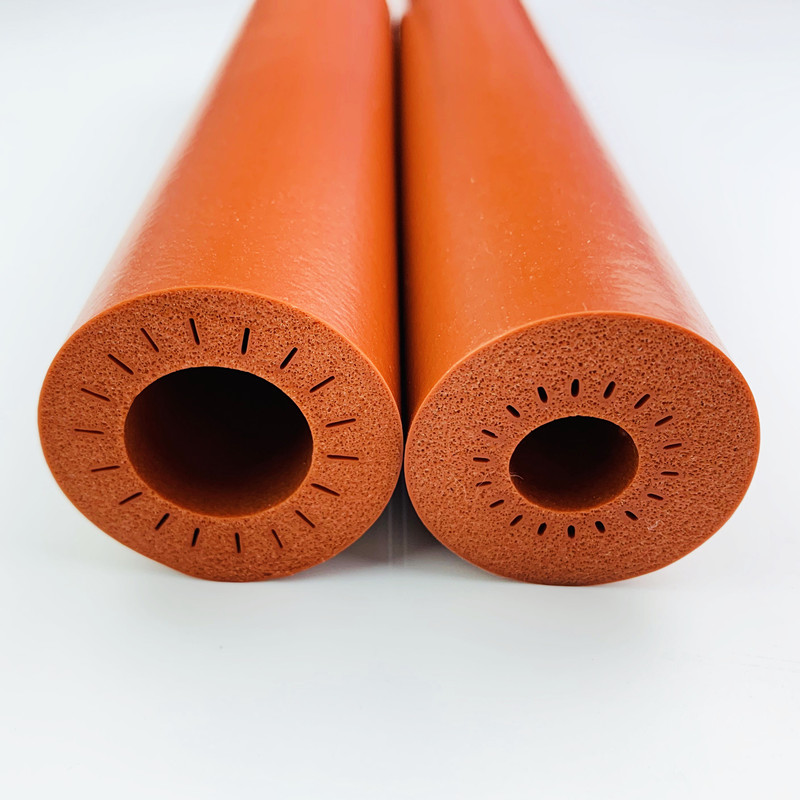
A foam silicone tube is manufactured by introducing a controlled foaming system into the silicone compound. During heating and vulcanization, gas is released, forming a uniform microcellular structure inside the tube wall.
Key characteristics of foam silicone tube:
- Lower density than solid silicone tube
- Microcell or closed-cell internal structure
- Soft, elastic, and highly compressible
- Excellent cushioning and rebound performance
- Reduced material weight and improved energy absorption
Foam silicone tubing is especially suitable for applications where flexibility, shock absorption, or surface compliance is required.
Structural Differences: Foam vs Solid
The most fundamental difference lies in internal structure:
- Solid silicone tube: Completely dense, no pores
- Foam silicone tube: Contains evenly distributed micro air cells
This structural difference directly affects how the tube behaves under compression, vibration, and repeated mechanical contact.
Solid silicone tube resists deformation and maintains shape under pressure. Foam silicone tube compresses easily and returns to its original shape, providing a cushioning effect.
Performance Comparison in Practical Use
Flexibility and Softness
Foam silicone tube is significantly softer than solid silicone tube at the same outer diameter. This makes foam silicone tubing ideal for applications requiring gentle contact, such as rollers, seals, or protective sleeves.
Solid silicone tube, while flexible, provides firmer support and is better suited for structural or pressure-bearing roles.
Compression and Rebound
Foam silicone tube offers superior compression recovery. When compressed repeatedly, it maintains elasticity and does not permanently deform if properly designed.
Solid silicone tube shows limited compression but excellent shape retention under static load.
Weight and Material Efficiency
Because of its internal foam structure, foam silicone tube is lighter than solid silicone tube. This can be advantageous in moving components or large-volume installations where weight reduction matters.
Solid silicone tube uses more raw material, resulting in higher density and, in many cases, higher cost per unit length.
Thermal and Insulation Properties
Foam silicone tube naturally provides better thermal insulation due to trapped air inside the structure. This helps reduce heat transfer and surface temperature.
Solid silicone tube conducts heat more efficiently and is often preferred when heat dissipation or stable thermal transmission is required.
Durability and Service Life
Both foam silicone tube and solid silicone tube offer excellent resistance to:
- UV exposure
- Ozone
- Aging
- Temperature cycling
However, their durability manifests differently:
- Foam silicone tube excels in dynamic environments involving repeated contact, vibration, or compression.
- Solid silicone tube performs better under constant pressure, fluid flow, or chemical exposure.
Choosing the right type depends on the mechanical stress profile of the application.
Typical Selection Considerations
A foam silicone tube is typically selected when:
- Soft contact is required
- Cushioning or vibration damping is needed
- Lightweight design is important
- Surface compliance improves performance
A solid silicone tube is typically selected when:
- Dimensional stability is critical
- Internal pressure must be controlled
- Smooth, non-porous surfaces are required
- Precise inner diameter is essential
Conclusion
Although foam silicone tube and solid silicone tube share the same silicone foundation, they are engineered for different performance goals. Foam silicone tube prioritizes softness, elasticity, and cushioning, while solid silicone tube emphasizes strength, stability, and consistency.
Understanding these differences allows manufacturers and engineers to select the most suitable silicone tube for their specific requirements, improving product reliability, efficiency, and lifespan.

点击右上角
分享给朋友吧







 Long by picture save/share
0
Popular
-
top Colored Silicone Tube: Production Process and How to Choose
-
top Enhancing the Lifespan of High-Temperature Silicone Tubes in...
-
top Introducing the Innovative Foam Silicone Tube: A High-Perfor...
-
The evolution and future of silicone material: a panoramic a...
-
Dongguan Yutian Silicone Rubber Technology Co., Ltd. Unveils...
-
Understanding the Causes of Bending and Clogging in Food-Gra...
-
Explore Cutting-Edge Silicone Solutions with Dongguan Yutian...
-
Dongguan Yutian Successfully Showcases Innovative Medical Si...
Latest Products








Message
Hi!If you are looking for custom-made silicone rubber products, feel free to ask me any questions.
Foam Silicone Tube vs Solid Silicone Tube: Key Differences, Performance Comparison, and Application Insights
Author:Dongguan Yutian Silicone Rubber Technology Co., Lt
Click:
Time:2026-01-17 11:46:41
Introduction
Silicone tubing is widely used across industrial, medical, printing, and equipment manufacturing sectors. Among the many options available, foam silicone tube and solid silicone tube are two common but fundamentally different materials. While they share the same base polymer, their internal structures, physical behavior, and performance characteristics differ significantly.
Understanding the difference between a foam silicone tube and a solid silicone tube is essential for engineers, product designers, and procurement teams. Choosing the wrong type may lead to unnecessary cost, reduced performance, or premature product failure. This article provides a clear, technical comparison to help you make an informed decision.
What Is a Solid Silicone Tube?
A solid silicone tube is made from fully dense silicone rubber with no internal pores. It is produced through extrusion and vulcanization, resulting in a uniform, compact structure.
Key characteristics of solid silicone tube:
- High material density
- Stable mechanical strength
- Smooth internal and external surfaces
- Excellent chemical resistance
- Reliable temperature resistance (typically -40°C to 200°C, higher with special grades)
Because of its dense structure, a solid silicone tube maintains dimensional stability under pressure and is commonly used for fluid transfer, medical devices, and food-grade applications where consistency and cleanliness are critical.
What Is a Foam Silicone Tube?
A foam silicone tube is manufactured by introducing a controlled foaming system into the silicone compound. During heating and vulcanization, gas is released, forming a uniform microcellular structure inside the tube wall.
Key characteristics of foam silicone tube:
- Lower density than solid silicone tube
- Microcell or closed-cell internal structure
- Soft, elastic, and highly compressible
- Excellent cushioning and rebound performance
- Reduced material weight and improved energy absorption
Foam silicone tubing is especially suitable for applications where flexibility, shock absorption, or surface compliance is required.
Structural Differences: Foam vs Solid
The most fundamental difference lies in internal structure:
- Solid silicone tube: Completely dense, no pores
- Foam silicone tube: Contains evenly distributed micro air cells
This structural difference directly affects how the tube behaves under compression, vibration, and repeated mechanical contact.
Solid silicone tube resists deformation and maintains shape under pressure. Foam silicone tube compresses easily and returns to its original shape, providing a cushioning effect.
Performance Comparison in Practical Use
Flexibility and Softness
Foam silicone tube is significantly softer than solid silicone tube at the same outer diameter. This makes foam silicone tubing ideal for applications requiring gentle contact, such as rollers, seals, or protective sleeves.
Solid silicone tube, while flexible, provides firmer support and is better suited for structural or pressure-bearing roles.
Compression and Rebound
Foam silicone tube offers superior compression recovery. When compressed repeatedly, it maintains elasticity and does not permanently deform if properly designed.
Solid silicone tube shows limited compression but excellent shape retention under static load.
Weight and Material Efficiency
Because of its internal foam structure, foam silicone tube is lighter than solid silicone tube. This can be advantageous in moving components or large-volume installations where weight reduction matters.
Solid silicone tube uses more raw material, resulting in higher density and, in many cases, higher cost per unit length.
Thermal and Insulation Properties
Foam silicone tube naturally provides better thermal insulation due to trapped air inside the structure. This helps reduce heat transfer and surface temperature.
Solid silicone tube conducts heat more efficiently and is often preferred when heat dissipation or stable thermal transmission is required.
Durability and Service Life
Both foam silicone tube and solid silicone tube offer excellent resistance to:
- UV exposure
- Ozone
- Aging
- Temperature cycling
However, their durability manifests differently:
- Foam silicone tube excels in dynamic environments involving repeated contact, vibration, or compression.
- Solid silicone tube performs better under constant pressure, fluid flow, or chemical exposure.
Choosing the right type depends on the mechanical stress profile of the application.
Typical Selection Considerations
A foam silicone tube is typically selected when:
- Soft contact is required
- Cushioning or vibration damping is needed
- Lightweight design is important
- Surface compliance improves performance
A solid silicone tube is typically selected when:
- Dimensional stability is critical
- Internal pressure must be controlled
- Smooth, non-porous surfaces are required
- Precise inner diameter is essential
Conclusion
Although foam silicone tube and solid silicone tube share the same silicone foundation, they are engineered for different performance goals. Foam silicone tube prioritizes softness, elasticity, and cushioning, while solid silicone tube emphasizes strength, stability, and consistency.
Understanding these differences allows manufacturers and engineers to select the most suitable silicone tube for their specific requirements, improving product reliability, efficiency, and lifespan.
点击右上角
分享给朋友吧
Long by picture save/share
0
Popular
Popular
Popular
Popular
-
top Colored Silicone Tube: Production Process and How to Choose
-
top Enhancing the Lifespan of High-Temperature Silicone Tubes in...
-
top Introducing the Innovative Foam Silicone Tube: A High-Perfor...
-
The evolution and future of silicone material: a panoramic a...
-
Dongguan Yutian Silicone Rubber Technology Co., Ltd. Unveils...
-
Understanding the Causes of Bending and Clogging in Food-Gra...
-
Explore Cutting-Edge Silicone Solutions with Dongguan Yutian...
-
Dongguan Yutian Successfully Showcases Innovative Medical Si...
Latest Products
Message
 Brown Di
 Brown Di