

Demand Submission
Please leave us a message and we will contact you within 24 hours
NEWS CENTER
A variety of production processes, research and development, production, sales integration
NEWS CENTER
A variety of production processes, research and development, production, sales integration
How Medical Companies Select Silicone Tubing for Peristaltic Pump Applications
Time: 2026-02-02 00:56:06
Author: Dongguan Yutian Silicone Rubber Technology Co., Lt
Click:
This article outlines the key factors medical companies consider when selecting silicone tubing for peristaltic pumps. It covers regulatory compliance, material safety, tubing life, dimensional consistency, sterilization compatibility, and supply stability, helping medical device manufacturers choose reliable tubing for critical fluid transfer applications.
In medical devices, a peristaltic pump relies heavily on the performance of its tubing. Unlike conventional fluid transfer systems, the tubing itself becomes a functional component of the pump, subjected to continuous compression, recovery, and direct contact with sensitive fluids.
For medical companies, selecting medical grade silicone tubing for peristaltic pumps is not a price-driven decision. It is a risk-controlled engineering choice directly related to patient safety, dosing accuracy, and regulatory compliance.
Regulatory Compliance as the First Qualification Step
Medical procurement teams begin evaluation by confirming that the silicone tubing meets recognized medical standards. Common references include USP Class VI, ISO 10993, and FDA 21 CFR 177.2600.
These standards address biocompatibility, cytotoxicity, and material safety. Without a clear compliance pathway, further technical evaluation is typically discontinued.
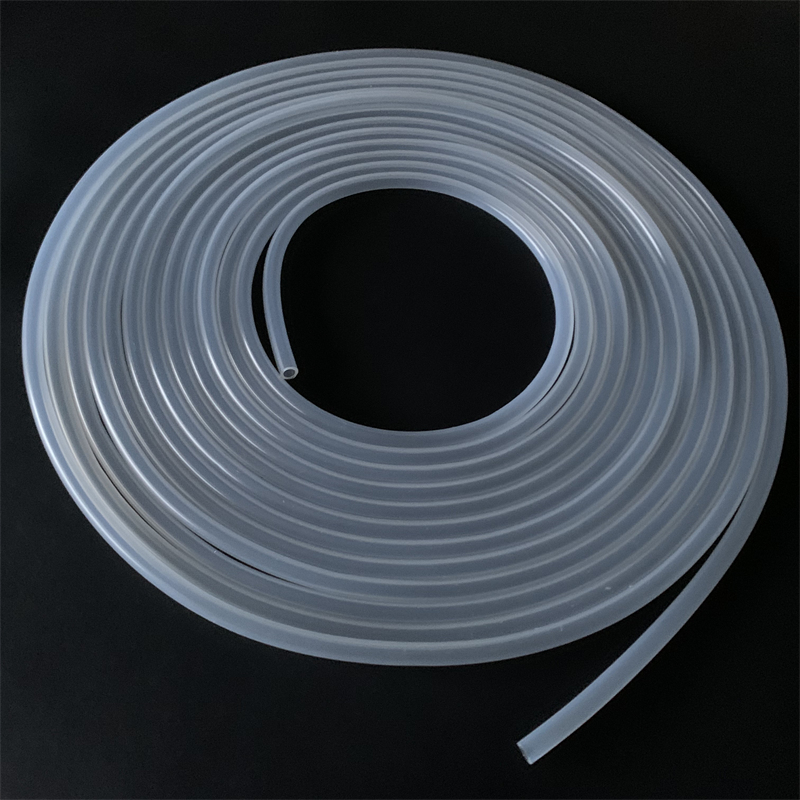
Material Selection and Biocompatibility
For peristaltic pump applications, medical companies strongly prefer platinum-cured silicone tubing. Compared with peroxide-cured alternatives, platinum curing produces a more chemically stable material with lower extractables and minimal odor.
This stability is critical when tubing is used to transport pharmaceuticals, biological solutions, or diagnostic reagents, where any material-fluid interaction introduces unacceptable risk.
Tubing Life Under Continuous Mechanical Compression
In a peristaltic pump, silicone tubing is repeatedly compressed by pump rollers, often for millions of cycles. Medical engineers therefore focus on tubing life rather than short-term performance.
Key evaluation criteria include resistance to compression set, elastic recovery after deformation, and the ability to maintain a stable internal diameter over extended operation. Loss of elasticity can directly affect flow accuracy and pump reliability.
Dimensional Accuracy and Flow Consistency
Precise fluid control is fundamental in medical devices. Even small variations in tubing inner diameter can cause measurable changes in flow rate and dosing accuracy.
Medical companies therefore place strong emphasis on tight dimensional tolerances, batch-to-batch consistency, and long-term repeatability of silicone tubing used in peristaltic pumps.
Compatibility with Sterilization and Cleaning Processes
Medical silicone tubing is often exposed to sterilization processes before use. Common methods include autoclaving, gamma irradiation, and ethylene oxide treatment.
Medical buyers evaluate how these processes affect material flexibility, transparency, and mechanical strength. Tubing that degrades or changes properties after sterilization increases validation complexity and regulatory risk.
Traceability and Long-Term Supply Stability
Beyond material performance, medical companies require reliable traceability. Batch identification, raw material consistency, and controlled manufacturing processes are essential for long-term device support.
Stable supply over the full lifecycle of a medical device helps reduce revalidation costs and ensures continuity in regulated production environments.
Documentation and Technical Communication
Medical companies value suppliers who provide clear and accurate technical documentation rather than promotional claims. Technical data sheets, material descriptions, and defined performance limits support design verification and regulatory submissions.
Effective technical communication between the silicone tubing manufacturer and the medical device OEM is critical to long-term project success.
Conclusion
For medical companies, selecting silicone tubing for peristaltic pump applications is a multidisciplinary decision involving regulatory compliance, material science, mechanical durability, and supply stability.
High-quality medical grade silicone tubing provides predictable performance throughout validation and clinical use, supporting patient safety and long-term device reliability.

点击右上角
分享给朋友吧







 Long by picture save/share
0
Popular
-
top Colored Silicone Tube: Production Process and How to Choose
-
top Enhancing the Lifespan of High-Temperature Silicone Tubes in...
-
top Introducing the Innovative Foam Silicone Tube: A High-Perfor...
-
The evolution and future of silicone material: a panoramic a...
-
Dongguan Yutian Silicone Rubber Technology Co., Ltd. Unveils...
-
Understanding the Causes of Bending and Clogging in Food-Gra...
-
Explore Cutting-Edge Silicone Solutions with Dongguan Yutian...
-
Dongguan Yutian Successfully Showcases Innovative Medical Si...
Latest Products







Message
Hi!If you are looking for custom-made silicone rubber products, feel free to ask me any questions.
How Medical Companies Select Silicone Tubing for Peristaltic Pump Applications
Author:Dongguan Yutian Silicone Rubber Technology Co., Lt
Click:
Time:2026-02-02 00:56:06
In medical devices, a peristaltic pump relies heavily on the performance of its tubing. Unlike conventional fluid transfer systems, the tubing itself becomes a functional component of the pump, subjected to continuous compression, recovery, and direct contact with sensitive fluids.
For medical companies, selecting medical grade silicone tubing for peristaltic pumps is not a price-driven decision. It is a risk-controlled engineering choice directly related to patient safety, dosing accuracy, and regulatory compliance.
Regulatory Compliance as the First Qualification Step
Medical procurement teams begin evaluation by confirming that the silicone tubing meets recognized medical standards. Common references include USP Class VI, ISO 10993, and FDA 21 CFR 177.2600.
These standards address biocompatibility, cytotoxicity, and material safety. Without a clear compliance pathway, further technical evaluation is typically discontinued.
Material Selection and Biocompatibility
For peristaltic pump applications, medical companies strongly prefer platinum-cured silicone tubing. Compared with peroxide-cured alternatives, platinum curing produces a more chemically stable material with lower extractables and minimal odor.
This stability is critical when tubing is used to transport pharmaceuticals, biological solutions, or diagnostic reagents, where any material-fluid interaction introduces unacceptable risk.
Tubing Life Under Continuous Mechanical Compression
In a peristaltic pump, silicone tubing is repeatedly compressed by pump rollers, often for millions of cycles. Medical engineers therefore focus on tubing life rather than short-term performance.
Key evaluation criteria include resistance to compression set, elastic recovery after deformation, and the ability to maintain a stable internal diameter over extended operation. Loss of elasticity can directly affect flow accuracy and pump reliability.
Dimensional Accuracy and Flow Consistency
Precise fluid control is fundamental in medical devices. Even small variations in tubing inner diameter can cause measurable changes in flow rate and dosing accuracy.
Medical companies therefore place strong emphasis on tight dimensional tolerances, batch-to-batch consistency, and long-term repeatability of silicone tubing used in peristaltic pumps.
Compatibility with Sterilization and Cleaning Processes
Medical silicone tubing is often exposed to sterilization processes before use. Common methods include autoclaving, gamma irradiation, and ethylene oxide treatment.
Medical buyers evaluate how these processes affect material flexibility, transparency, and mechanical strength. Tubing that degrades or changes properties after sterilization increases validation complexity and regulatory risk.
Traceability and Long-Term Supply Stability
Beyond material performance, medical companies require reliable traceability. Batch identification, raw material consistency, and controlled manufacturing processes are essential for long-term device support.
Stable supply over the full lifecycle of a medical device helps reduce revalidation costs and ensures continuity in regulated production environments.
Documentation and Technical Communication
Medical companies value suppliers who provide clear and accurate technical documentation rather than promotional claims. Technical data sheets, material descriptions, and defined performance limits support design verification and regulatory submissions.
Effective technical communication between the silicone tubing manufacturer and the medical device OEM is critical to long-term project success.
Conclusion
For medical companies, selecting silicone tubing for peristaltic pump applications is a multidisciplinary decision involving regulatory compliance, material science, mechanical durability, and supply stability.
High-quality medical grade silicone tubing provides predictable performance throughout validation and clinical use, supporting patient safety and long-term device reliability.
点击右上角
分享给朋友吧
Long by picture save/share
0
Popular
Popular
Popular
Popular
-
top Colored Silicone Tube: Production Process and How to Choose
-
top Enhancing the Lifespan of High-Temperature Silicone Tubes in...
-
top Introducing the Innovative Foam Silicone Tube: A High-Perfor...
-
The evolution and future of silicone material: a panoramic a...
-
Dongguan Yutian Silicone Rubber Technology Co., Ltd. Unveils...
-
Understanding the Causes of Bending and Clogging in Food-Gra...
-
Explore Cutting-Edge Silicone Solutions with Dongguan Yutian...
-
Dongguan Yutian Successfully Showcases Innovative Medical Si...
Latest Products
Message
 Brown Di
 Brown Di