

Demand Submission
Please leave us a message and we will contact you within 24 hours
APPLICATION
Our silicone products are used in all walks of life
APPLICATION
Our silicone products are used in all walks of life
What Tubing Do Oxygen Concentrators Use? A Selection Guide
2026-10-21 12:03:38
Click:
“
Oxygen concentrators use medical grade tubing along the gas path, from the compressor and sieve beds to the flowmeter, humidifier and cannula. This guide maps each section, compares silicone, PVC and TPE, and shows when braided hose and which dimensions to specify.
”
Application Guide · Oxygen Concentrators
Oxygen concentrators use medical grade tubing along the gas path — from the compressor and sieve beds through the storage tank and flowmeter to the humidifier and the patient interface. Most of that path sees low pressure; sections that must resist vacuum, pressure pulses or repeated bending are where reinforced, braided hose earns its place. Concentrator designs vary, so treat this as a map of the duties, not a service manual.
| Gas path7 sectionsCompressor to cannula | Standard braidID 3–31.75 mmPolyester yarn, 11 models | Large boreID 19–102 mmMesh or steel wire braid | Service range−40 to +200 °C−40 to 392 °F |
How an oxygen concentrator works
A concentrator takes room air and raises the oxygen fraction instead of storing oxygen. The common method is pressure swing adsorption. Air is compressed and passed through a bed of adsorbent — usually a zeolite molecular sieve — which holds nitrogen more strongly than oxygen. The bed is then regenerated by releasing pressure, and the cycle repeats, often across two beds so the flow stays continuous. The oxygen-enriched gas goes to a small storage tank or buffer, through a regulator and flowmeter, optionally through a humidifier, and out to the patient through a cannula.
Designs vary. Portable units package the same duties differently, some devices add filters, sensors and valves in different places, and the tubing runs are not identical between models. Nothing here replaces the device manufacturer's service information or a clinician's advice; it is a guide to what the tubing has to do.
That is the frame for the question buyers actually search: what tubing do oxygen concentrators use? The honest answer is that one tube does not cover the whole path. Each section has a different duty, and the duty picks the tube.
Tubing by section
The oxygen concentrator tubing material matters most where the duty is hardest: the compressor outlet, the sieve bed connections and any line that is bent tightly inside a small case. The rest of the path is mostly low-pressure gas transfer, where cleanliness and a reliable connection matter more than pressure capability.
| Section | Duty | What the tubing needs |
|---|---|---|
| Intake and compressor | Pulsing flow, some heat, vibration | Flexible, heat-tolerant, resistant to pressure pulses; a braided line is common here |
| Sieve beds | Pressure swing and vacuum purge | The sieve bed tubing sees both pressure and vacuum, so it is the strongest case for reinforced hose |
| Storage and regulation | Steady low pressure | Clean bore, secure connections, low extractables |
| Flowmeter | Low pressure, measured flow | Stable bore, no kink at the bend behind the panel |
| Humidifier | Moist gas, occasional water | The humidifier tubing must tolerate moisture and cleaning; avoid a low point that traps water |
| Patient interface | Light, flexible, repeated handling | Nasal cannula tubing is usually light-wall and soft; it is a different requirement from the hose inside the case |
| Replacement runs | Field service, matched to the original | Oxygen tubing replacement needs the same bore, wall and fittings as the part it replaces |
Which material and why
The respiratory tubing material choice is usually silicone, PVC or a thermoplastic elastomer. All three are used in medical devices; they differ in flexibility, temperature capability and what they release. The comparison below is deliberately general — formulation decides the actual performance, and this is not a claim about any other supplier's product.
| Property | Silicone | PVC | TPE |
|---|---|---|---|
| Flexibility | High, and retained over a wide temperature band | Good, with plasticiser-dependent feel | Good, tunable by formulation |
| Temperature | −40 to +200 °C on our braided range | Lower ceiling; softens earlier | Between the two, formulation-dependent |
| Extractables and odor | Low when platinum-cured and well post-cured | Plasticiser migration is the usual concern | Generally low; compound-dependent |
| Transparency | Can be water-clear | Usually clear | Clear to translucent |
| Typical role | Pressure, vacuum and heat duty inside the device | Low-cost gas transfer, patient-side tubing | Flexible patient-side and general tubing |
For the internal runs of a concentrator, silicone is the usual choice because it keeps its flexibility and carries the temperature without plasticiser concerns. For the patient side, weight and feel often decide more than technical performance. Both are legitimate; the mistake is using a low-pressure material for a section that pulses.
Plain tubing vs braided hose
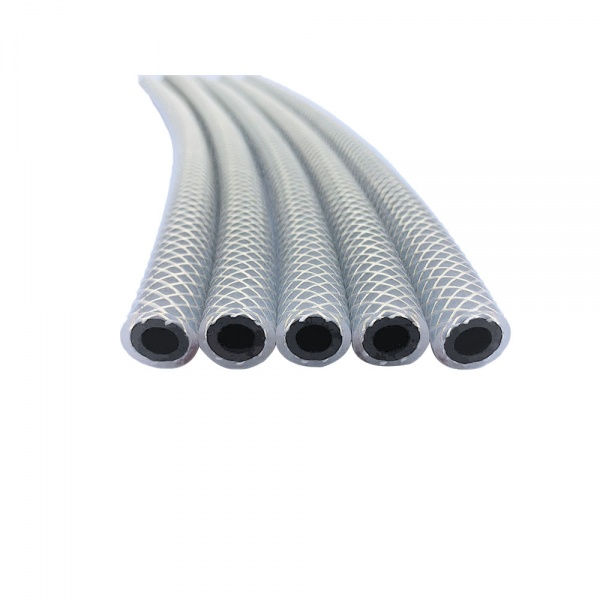
Plain silicone tubing is enough for steady, low-pressure gas transfer. A braided hose is specified when the line has to hold shape or survive duty that plain tube cannot: full vacuum without collapse, repeated pressure pulses, a tight bend radius, or a run that is handled and re-routed in service. The braid carries the load so the silicone bore stays open.
Our standard polyester-braided hose covers ID 3–31.75 mm in eleven models, with minimum burst from ≥ 38 kg/cm² (3.73 MPa) at the small end to ≥ 12 kg/cm² (1.18 MPa) at ID 31.75 mm. Those are burst values, not working pressures; the working pressure for a given line is set by your design standard and the safety factor it applies. The full table and what full-vacuum capability means are in the burst pressure and vacuum guide.
Large-bore runs — the mesh-braided and steel-wire-braided constructions — start at ID 19 mm and go to ID 102 mm. They are separate constructions with their own published data, not scaled-up versions of the polyester braid.
Selection checklist
Write these down before you ask for a quotation. Most delays in a concentrator tubing project come from a missing dimension or a missing duty, not from the material.
| Input | What to state |
|---|---|
| Bore and wall | ID and OD, or ID and wall; tolerance if the drawing has one |
| Pressure and vacuum | Working pressure, peak pressure, vacuum level and whether it is continuous |
| Temperature | Continuous temperature and any cleaning or peak temperature |
| Bend radius | The tightest installed bend, measured to the center line |
| Connections | Barb, clamp, thread or a specific fitting; whether the hose is supplied as an assembly |
| Hardness and color | Shore A target and whether transparency or a color is required |
| Documentation | Cleanroom, ISO 10993 reports, ISO 13485, certificate of analysis, data sheet |
| Packaging and quantity | Coil length or straight length, bag or box, annual and first-order quantity |
Common failure modes and prevention
Kinking at a tight bend. A plain tube collapses when the installed radius is below its limit. Prevention: give the real bend radius in the enquiry, or specify a braided hose where the layout is tight.
Hardening and ageing. Heat, ozone and some cleaning agents stiffen any elastomer over time. Prevention: keep the line inside the published temperature range, check the cleaning chemistry and replace on a service interval rather than on failure.
Leaks at connections. A barb that is the wrong size, a clamp in the wrong place or a tube that has taken a set will leak under pressure. Prevention: specify the fitting with the hose, and test the assembly rather than the tube alone.
Contamination. Moisture in the humidifier line, cleaning residue or dust from an open coil can all end up in the gas path. Prevention: cap the ends, pack in clean conditions and confirm the cleaning route before the first order.
Frequently asked questions
What tubing do oxygen concentrators use?
Most use medical grade silicone tubing on the gas path, with braided hose on the sections that see pressure, vacuum or a tight bend. Some designs use PVC or TPE for low-pressure and patient-side runs. The section duty decides the material, not one blanket choice.
Is silicone the only suitable material?
No. PVC and TPE are used where their properties fit, especially on the patient side. Silicone is usually chosen where flexibility, temperature capability and low extractables matter together. The right answer follows the duty and the device documentation.
When is braided hose needed instead of plain tubing?
When the line must hold full vacuum without collapsing, survive repeated pressure pulses, or bend tighter than plain tube allows. If none of those apply, plain tubing is usually the simpler and cheaper choice.
What sizes are available?
The standard polyester-braided range covers ID 3–31.75 mm in eleven models. Mesh-braided and steel-wire-braided hose cover ID 19–102 mm in seven models each. Outside those tables we quote to the bore you specify.
Can you supply an oxygen concentrator hose replacement?
Yes. Send the original dimensions, a drawing or a sample, plus the fittings and the documentation the device requires. In-stock samples ship in 3 days, standard items in 5–7 days, and custom builds typically in 10–20 working days.
Which medical documents can you provide?
Depending on the order: cleanroom production, ISO 10993 biocompatibility reports — cytotoxicity, skin sensitization and skin irritation — and ISO 13485 according to customer requirements, plus a data sheet and certificate of analysis. Our hose is not for human implant.
Related reading
- Polyester braided silicone hose construction — liner, braid and cover, and the yarn options.
- Burst pressure and vacuum ratings — how the figures are published and what full vacuum means.
- Braided silicone hose for oxygen concentrators — the cluster overview and sourcing checklist.
- Standard braided silicone tube — the eleven-model range.
- Silicone oxygen supply tube — the patient-side tubing range.
Next step
Send the section, the duty and the dimensions. If the run is a replacement, a photo of the original and its fittings is often faster than a drawing. We reply with the construction, the documentation and the lead time.
Need tubing for a concentrator project?
Tell us the section, pressure or vacuum duty, dimensions and documentation; we reply with the construction, the lead time and the price basis.
DongGuan Yutian Silicone Rubber Technology Co., Ltd — silicone extrusion manufacturer since 2012. 6,800 m² facility · 14 extrusion lines · 4 calendering lines · 7 compression moulding lines · production team 90+ · management and sales team 50+ · Class 100,000 cleanroom · monthly capacity up to 8,000,000 meters. Certifications: FDA, ROHS, REACH, NSF, LFGB, ISO 13485, ISO 9001, ISO 14001:2015, and ISO 10993 biocompatibility — three reports (cytotoxicity, skin sensitization, skin irritation). Room 801, Building 10, No. 2 Tutang Industrial 2nd Heng Road, Changping Town, Dongguan, Guangdong, China. Not for human implant.
Author:
Dongguan Yutian Silicone Rubber Technology Co., Lt
0
Products Recommended






INQUIRY


Add Successfully
What Tubing Do Oxygen Concentrators Use? A Selection Guide
Author:Dongguan Yutian Silicone Rubber Technology Co., Lt
Application Guide · Oxygen Concentrators
Oxygen concentrators use medical grade tubing along the gas path — from the compressor and sieve beds through the storage tank and flowmeter to the humidifier and the patient interface. Most of that path sees low pressure; sections that must resist vacuum, pressure pulses or repeated bending are where reinforced, braided hose earns its place. Concentrator designs vary, so treat this as a map of the duties, not a service manual.
| Gas path7 sectionsCompressor to cannula | Standard braidID 3–31.75 mmPolyester yarn, 11 models | Large boreID 19–102 mmMesh or steel wire braid | Service range−40 to +200 °C−40 to 392 °F |
How an oxygen concentrator works
A concentrator takes room air and raises the oxygen fraction instead of storing oxygen. The common method is pressure swing adsorption. Air is compressed and passed through a bed of adsorbent — usually a zeolite molecular sieve — which holds nitrogen more strongly than oxygen. The bed is then regenerated by releasing pressure, and the cycle repeats, often across two beds so the flow stays continuous. The oxygen-enriched gas goes to a small storage tank or buffer, through a regulator and flowmeter, optionally through a humidifier, and out to the patient through a cannula.
Designs vary. Portable units package the same duties differently, some devices add filters, sensors and valves in different places, and the tubing runs are not identical between models. Nothing here replaces the device manufacturer's service information or a clinician's advice; it is a guide to what the tubing has to do.
That is the frame for the question buyers actually search: what tubing do oxygen concentrators use? The honest answer is that one tube does not cover the whole path. Each section has a different duty, and the duty picks the tube.
Tubing by section
The oxygen concentrator tubing material matters most where the duty is hardest: the compressor outlet, the sieve bed connections and any line that is bent tightly inside a small case. The rest of the path is mostly low-pressure gas transfer, where cleanliness and a reliable connection matter more than pressure capability.
| Section | Duty | What the tubing needs |
|---|---|---|
| Intake and compressor | Pulsing flow, some heat, vibration | Flexible, heat-tolerant, resistant to pressure pulses; a braided line is common here |
| Sieve beds | Pressure swing and vacuum purge | The sieve bed tubing sees both pressure and vacuum, so it is the strongest case for reinforced hose |
| Storage and regulation | Steady low pressure | Clean bore, secure connections, low extractables |
| Flowmeter | Low pressure, measured flow | Stable bore, no kink at the bend behind the panel |
| Humidifier | Moist gas, occasional water | The humidifier tubing must tolerate moisture and cleaning; avoid a low point that traps water |
| Patient interface | Light, flexible, repeated handling | Nasal cannula tubing is usually light-wall and soft; it is a different requirement from the hose inside the case |
| Replacement runs | Field service, matched to the original | Oxygen tubing replacement needs the same bore, wall and fittings as the part it replaces |
Which material and why
The respiratory tubing material choice is usually silicone, PVC or a thermoplastic elastomer. All three are used in medical devices; they differ in flexibility, temperature capability and what they release. The comparison below is deliberately general — formulation decides the actual performance, and this is not a claim about any other supplier's product.
| Property | Silicone | PVC | TPE |
|---|---|---|---|
| Flexibility | High, and retained over a wide temperature band | Good, with plasticiser-dependent feel | Good, tunable by formulation |
| Temperature | −40 to +200 °C on our braided range | Lower ceiling; softens earlier | Between the two, formulation-dependent |
| Extractables and odor | Low when platinum-cured and well post-cured | Plasticiser migration is the usual concern | Generally low; compound-dependent |
| Transparency | Can be water-clear | Usually clear | Clear to translucent |
| Typical role | Pressure, vacuum and heat duty inside the device | Low-cost gas transfer, patient-side tubing | Flexible patient-side and general tubing |
For the internal runs of a concentrator, silicone is the usual choice because it keeps its flexibility and carries the temperature without plasticiser concerns. For the patient side, weight and feel often decide more than technical performance. Both are legitimate; the mistake is using a low-pressure material for a section that pulses.
Plain tubing vs braided hose
Plain silicone tubing is enough for steady, low-pressure gas transfer. A braided hose is specified when the line has to hold shape or survive duty that plain tube cannot: full vacuum without collapse, repeated pressure pulses, a tight bend radius, or a run that is handled and re-routed in service. The braid carries the load so the silicone bore stays open.
Our standard polyester-braided hose covers ID 3–31.75 mm in eleven models, with minimum burst from ≥ 38 kg/cm² (3.73 MPa) at the small end to ≥ 12 kg/cm² (1.18 MPa) at ID 31.75 mm. Those are burst values, not working pressures; the working pressure for a given line is set by your design standard and the safety factor it applies. The full table and what full-vacuum capability means are in the burst pressure and vacuum guide.
Large-bore runs — the mesh-braided and steel-wire-braided constructions — start at ID 19 mm and go to ID 102 mm. They are separate constructions with their own published data, not scaled-up versions of the polyester braid.
Selection checklist
Write these down before you ask for a quotation. Most delays in a concentrator tubing project come from a missing dimension or a missing duty, not from the material.
| Input | What to state |
|---|---|
| Bore and wall | ID and OD, or ID and wall; tolerance if the drawing has one |
| Pressure and vacuum | Working pressure, peak pressure, vacuum level and whether it is continuous |
| Temperature | Continuous temperature and any cleaning or peak temperature |
| Bend radius | The tightest installed bend, measured to the center line |
| Connections | Barb, clamp, thread or a specific fitting; whether the hose is supplied as an assembly |
| Hardness and color | Shore A target and whether transparency or a color is required |
| Documentation | Cleanroom, ISO 10993 reports, ISO 13485, certificate of analysis, data sheet |
| Packaging and quantity | Coil length or straight length, bag or box, annual and first-order quantity |
Common failure modes and prevention
Kinking at a tight bend. A plain tube collapses when the installed radius is below its limit. Prevention: give the real bend radius in the enquiry, or specify a braided hose where the layout is tight.
Hardening and ageing. Heat, ozone and some cleaning agents stiffen any elastomer over time. Prevention: keep the line inside the published temperature range, check the cleaning chemistry and replace on a service interval rather than on failure.
Leaks at connections. A barb that is the wrong size, a clamp in the wrong place or a tube that has taken a set will leak under pressure. Prevention: specify the fitting with the hose, and test the assembly rather than the tube alone.
Contamination. Moisture in the humidifier line, cleaning residue or dust from an open coil can all end up in the gas path. Prevention: cap the ends, pack in clean conditions and confirm the cleaning route before the first order.
Frequently asked questions
What tubing do oxygen concentrators use?
Most use medical grade silicone tubing on the gas path, with braided hose on the sections that see pressure, vacuum or a tight bend. Some designs use PVC or TPE for low-pressure and patient-side runs. The section duty decides the material, not one blanket choice.
Is silicone the only suitable material?
No. PVC and TPE are used where their properties fit, especially on the patient side. Silicone is usually chosen where flexibility, temperature capability and low extractables matter together. The right answer follows the duty and the device documentation.
When is braided hose needed instead of plain tubing?
When the line must hold full vacuum without collapsing, survive repeated pressure pulses, or bend tighter than plain tube allows. If none of those apply, plain tubing is usually the simpler and cheaper choice.
What sizes are available?
The standard polyester-braided range covers ID 3–31.75 mm in eleven models. Mesh-braided and steel-wire-braided hose cover ID 19–102 mm in seven models each. Outside those tables we quote to the bore you specify.
Can you supply an oxygen concentrator hose replacement?
Yes. Send the original dimensions, a drawing or a sample, plus the fittings and the documentation the device requires. In-stock samples ship in 3 days, standard items in 5–7 days, and custom builds typically in 10–20 working days.
Which medical documents can you provide?
Depending on the order: cleanroom production, ISO 10993 biocompatibility reports — cytotoxicity, skin sensitization and skin irritation — and ISO 13485 according to customer requirements, plus a data sheet and certificate of analysis. Our hose is not for human implant.
Related reading
- Polyester braided silicone hose construction — liner, braid and cover, and the yarn options.
- Burst pressure and vacuum ratings — how the figures are published and what full vacuum means.
- Braided silicone hose for oxygen concentrators — the cluster overview and sourcing checklist.
- Standard braided silicone tube — the eleven-model range.
- Silicone oxygen supply tube — the patient-side tubing range.
Next step
Send the section, the duty and the dimensions. If the run is a replacement, a photo of the original and its fittings is often faster than a drawing. We reply with the construction, the documentation and the lead time.
Need tubing for a concentrator project?
Tell us the section, pressure or vacuum duty, dimensions and documentation; we reply with the construction, the lead time and the price basis.
DongGuan Yutian Silicone Rubber Technology Co., Ltd — silicone extrusion manufacturer since 2012. 6,800 m² facility · 14 extrusion lines · 4 calendering lines · 7 compression moulding lines · production team 90+ · management and sales team 50+ · Class 100,000 cleanroom · monthly capacity up to 8,000,000 meters. Certifications: FDA, ROHS, REACH, NSF, LFGB, ISO 13485, ISO 9001, ISO 14001:2015, and ISO 10993 biocompatibility — three reports (cytotoxicity, skin sensitization, skin irritation). Room 801, Building 10, No. 2 Tutang Industrial 2nd Heng Road, Changping Town, Dongguan, Guangdong, China. Not for human implant.









Products Recommended
INQUIRY
Add Successfully
Products Recommended
Products Recommended
INQUIRY
Add Successfully
 Brown Di
 Brown Di